  The historical relief was as important an architectural member in
important civic and religious structures as the triumphal arch, the column,
the statue base, the temple and the altar. This portrayed, or rather narrated,
military campaigns and victories, processions and sacrifices, in fine detail.
Unlike the Hellenes who drew on
mythology to portray important moments in
their civic life (for example, the metope sculptures of
the Parthenon, showing battles with Amazons,
Centaurs and Giants, have been interpreted as
symbolizing their battles against the
Persians) the Romans prized faithful realistic
iconographic rendering of historical fact.
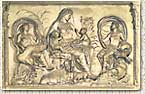 Even so, Hellenic art did influence
the morphology of Roman historical relief; many scholars have detected
the influence of the Parthenon frieze in Ara Pacis frieze,
the altar to Peace at Rome. It shows the
inauguration ceremony for the monument following Augustus'
victorious campaign in Gaul and Spain (13 B.C.),
as well as the procession of Roman dignitaries and priests with
Augustus himself and members of the imperial family. The
classicism of the frieze and the simplicity
and clarity of its figures are due to the fact that the
work was executed by Hellene artists.
Even so, Hellenic art did influence
the morphology of Roman historical relief; many scholars have detected
the influence of the Parthenon frieze in Ara Pacis frieze,
the altar to Peace at Rome. It shows the
inauguration ceremony for the monument following Augustus'
victorious campaign in Gaul and Spain (13 B.C.),
as well as the procession of Roman dignitaries and priests with
Augustus himself and members of the imperial family. The
classicism of the frieze and the simplicity
and clarity of its figures are due to the fact that the
work was executed by Hellene artists.

The earliest historical relief on Hellenic soil is the
monument of the Roman general Aemilius Paulus at Delphi.
A long frieze with scenes from the battle of Pydna (168 B.C.)
runs round the upper section of a tall rectangular base, on top
of which was an equestrian statue of Aemilius. The monument was
carved by Hellene craftsmen, and was originally intended
for Perseus, the defeated king of Macedon.
Of great importance is the frieze of the great
altar honouring the emperors Marcus Aurelius and Lucius
Verus at Ephesus. The altar was dedicated to their
victory over the Parthians (161-5 A.D.). The frieze
bears crowded compositions, scenes of sacrifice, battle,
and triumph. The overall conception of the monument may
have been Roman, but the dominant technique is Hellenic,
in the tradition of the school of Pergamum, which maintained
its influence over Ephesus even in the Imperial
Age.
The bas-reliefs on the triumphal arch erected by the
emperor Galerius at Thessaloniki show the emperor's
Persian campaign of (296 A.D.). The symmetry, and
hierarchy of the figures' proportions, the depiction of
battle scenes - all betray a distinctly
Hellenic technique. The details are kept separate by
decorative elements, and in the central scene the
dominant figure of Galerius is the keystone of the
picture's pyramidic layout. Numerous craftsmen
from different regions would have worked on this Roman
monument, unparallelled in the East.
|
