|
 The stadium
If there is one stadium that has been used both in war and in peace that is the Helsinki Olympic Stadium, which hosted the fifteenth Olympic Games.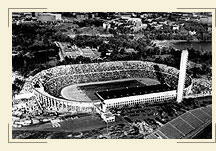
The stadium with the plain aspect that the architects Y. Lingren and T. Jontti lent to it, a typical example of architecture in the 1930s, began to be constructed in 1934. Four years later, when the IOC (International Olympic Committee) deprived Tokyo of the organization of the 1940 Olympics due to the Russian-Japanese war and awarded the twelfth Olympic Games to Helsinki, the stadium was in the final phase of its construction.
However, those Games were never held, nor were the following ones, because of World War II. During the war, and more precisely in the period 1941-1944, Finland had often been attacked by the Soviet Union, in one of the regional conflicts that came with World War II. As a result, the stadium became one of the key points of the city's military defence against the air raids. During those operations, especially in early 1944, the stadium was often the target of bombardments, without having suffered big damages.
When the war ended, the Finns tried to undertake the Olympic Games of 1948, but eventually Helsinki was awarded the 1952 Olympics. Therefore, the preparations for the organization began from 1947, which was the year when began the reconstruction of the stadium. Among other things, new tiers were added and the capacity increased up to 70,000 seats. At the entrance of the stadium, was erected the statue of Paavo Nurmi. It was another way of giving tribute to the 56-year-old hero of Finnish sport. Near the stadium were constructed the swimming pool and the other venues where the sports would be carried out. About two kilometres from the stadium was built one of the two Olympic Villages.
The second Olympic Village was destined for the accommodation of the athletes from the Soviet Union and the other socialist countries and was situated further away, about eight kilometres from the stadium and the other sports installations. What the Soviets planned in their first participation in the Olympic Games was that their athletes stayed in Leningrad and from there fly to Helsinki, a solution that was not adopted finally. The existence of two Olympic Villages was never repeated in any following Olympic organization. However, the "distance" and the rivalry in particular among the athletes of the Soviet Union and the United States, specifically the association of sport with the Cold War that would characterize all the organizations until the 1990s, were perfectly reflected in the existence of two Olympic Villages in 1952.
|