|
 The
forgotten Jim Thorpee
The
forgotten Jim Thorpee
It
was common belief to most of the observers of the Los Angeles
Games that it was an altogether successful organization as
far as 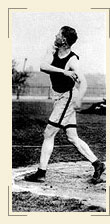 competition
and organization were concerned. However, an incident that
occurred during the Games spoiled the very good image that
the efforts of the organizers had created. competition
and organization were concerned. However, an incident that
occurred during the Games spoiled the very good image that
the efforts of the organizers had created.
The leading figure of the 1912 Stockholm Olympic Games, hero-worshipped
at that time by many of his fellow countrymen, was working
as a roadsweeper and was facing financial difficulties. It
seems that the forty-four-year-old Jim Thorpee had been forgotten
by many, despite his extraordinary appearance at the Games
held in the Swedish capital and also his adventure with the
deprivation of his medals by the IOC (International Olympic
Committee), due to the decision of its members to characterize
him a professional. Besides, 20 years had elapsed since his
triumphant return to New York and those who had not forgotten
his appearance in the Games of 1912 and his subsequent adventure,
remembered it as an unfortunate moment in the history of the
Games. Nevertheless, no-one had ever wondered as to Thorpee's
fate after the end of his career as a professional rugby player.
The former Olympic winner in the decathlon tried to enter
the stadium of the American megalopolis, but was denied entrance
because he did not have to pay for a ticket. Eventually his
desire to watch the Games was fulfilled when one of the spectators
noticed the incident, recognized him and offered to pay his
ticket. The above incident inflamed a large number of journalists
rousing them against the unacceptable attitude of the organizers
and their behaviour towards a legend of American sport. In
addition, Thorpee himself sent a letter of complaint to the
vice president of the USA Charles Curtis. The latter, after
the clamour that had been caused, invited the former Olympic
winner to attend the Games from the grandstand of the officials,
acknowledging the error of the organizers, but also Thorpee's
contribution to American sport.
|