|
 Ethelda
Bleibtrey
1920
was the year when the right of women to vote was constitutionally
secured in the United States, after decades of battles. 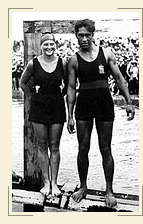 1920
was also the year of the seventh Olympic Games, in the programme
of which were included for the first time three swimming contests
for women. The winner in all three contests was Ethelda Bleibtrey,
an athlete who had associated her name not only with victories
and performances but also with the effort for women's participation
in the public arena on equal terms.
Bleibtrey was born in Waterford, New York on 27 February 1902.
At the age of sixteen she was infected by poliomyelitis. The
disease was the reason she took up sport. Her model was the
pioneer in women's swimming, Annette Kellerman, who had used
swimming therapeutically to strengthen her muscular system.
So, Bleibtrey turned to swimming. Two years later, in the
Olympic Games of Antwerp, she won three gold Olympic medals,
in the 100m and 300m freestyle and in the 4x100m freestyle
breaking the world records in all three contests. Before the
Games she had achieved the best performance in the breaststroke,
an event that was not included in the programme of the Olympics.
In the following years she was unbeatable in all the games
she had participated, either as an amateur or professional,
since in 1922 she abandoned amateur sport. Therefore, in Antwerp
it was the only opportunity for this great swimmer to participate
in the Olympic Games.
A year before the Antwerp Games, the seventeen-year-old Bleibtrey
had been arrested by the New York police for breaking the
law that prescribed the "advisable" outfit for women at sea.
The puritan municipal legislation of New York imposed on female
swimmers to wear thick tights, in order to cover the legs.
That measure, and other similar ones, had been abolished in
Great Britain and in other European countries due to the pressures
by the female movement in early 20th century. What Bleibtrey
did, take out the thick tights before swimming in the Manhattan
bay, led to her arrest and imprisonment. The ensuing public
debate at the media did not only result in her release from
prison but also in the abolishment of the said law. However,
Bleibtrey's action did not cease. Taking advantage of the
renown she gained as a swimmer in the Games of 1920, she embarked
on a large tour, giving demonstration games in many states
of the USA, in Australia, New Zealand and other countries,
propagating women's involvement in sport. Among those who
had contributed to her effort was the Olympic winner in swimming
Duke Kahanamoku and Gertrude Ederle, the first woman to swim
across the English Channel (La Manche) in the late 1920s.
Bleibtrey was arrested one more time, in 1928, during a protest
concerning the construction of a swimming pool in New York.
Bleibtrey continued to be involved in swimming even after
having given up competitive sport. She worked as a swimming
trainer and used swimming for therapeutic reasons mostly to
children and elderly people. She died on 6 May 1978.
|