|
The period after 1952 was characterized by the almost absolute
prevalence of the reconstructed conservative wing, as this was formed initially by Ellinikos Synagermos (Greek Rally)
and then by ERE (National Radical Union). Ellinikos Synagermos, which was to a large extent a developed form of the
anti-Venizelist party, was founded by the marshal Alexandros Papagos and represented - among others - the new middle
class. This was made up of the social groups, which sought to administer economically and socially the ‘reconstruction’,
the basic mobilization programme of that time.
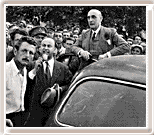
However, the parliamentary omnipotence of the Right did not waver after Papagos’ death. On the contrary, it enjoyed
the American favour, as well as the support of the Crown and saw its successor in the face of Konstantinos Karamanlis,
a dynamic young politician of that time. The entire opposition (EDA and parties of the Centre) rallied against
him - unsuccessfully though - in the elections of February 1956. In the following elections (1958), ERE, despite
the significant decrease of its power, retained parliamentary majority with the Left represented by EDA holding
for the first time the position of the main opposition/shadow government. However, social tensions engendered by
the economic choices of the government on one hand and the consolidation of the repressive methods on the other,
determined the election chart of the following decade.
 |
 |