 |

In common with the entire Balkan peninsula and the Mediterranean area in general, family ties and their local character constituted the basis of social organization in Greek society. Every family belonged to a locally defined network of relations, which consisted of many families related to each other on the basis of family ties between their male members. The extended group of relatives defined the majority of productive and socio-political activities of its members, offering them financial and social protection. Under these circumstances, the group of relatives constituted the fundamental field of definition of the public image of every family, both with respect to its relations with other groups of families, and to its transactions with the state.
Thus, the promotion of every family unit's interests in the Greek society of the 19th century usually depended on the reinforcement of the local network of relatives with which it was connected. Social strategies were organized for the formation of alliances with other organized groups of relatives for this purpose. The search for allies was based on the criteria of prestige and power existing at a local and peripheral level. The formation of these alliance relationships was attempted through the creation of new family ties, particularly by intermarriage, by having somebody be one's best man or by baptizing the children of others, by fraternizations and adoptions (adopted children). In this way, wider networks of mutual help and protection were formed. A family would be related through family ties with such networks, aiming to the upgrade its access and support, from the local level to the peripheral one, and finally to the centre of the economic, social and political life of the new state, that is, Athens.
The important role that family ties played in social life and consequently in public activities influenced, up to a certain point, the configuration of the public zone in the Greek kingdom. In particular, as far as the organization of the political field is concerned (e.g. organization of political parties), family ties and networks of interests functioned as mechanisms for the adaptation of traditional Greek society to the operation of the institutions of the modern state. To be precise, the adaptation of local networks of relatives to the operation of the modern political system caused Greek society to become familiar with the operation of institutions (e.g. political parties) and procedures (e.g. elections) which, even though not belonging to its own traditional political culture, were adopted relatively early in the Greek state.
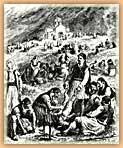
Picture: painting from a feast, religious celebration etc.
Caption: Religious celebrations and feasts were an opportunity for the creation of family ties. Fraternizations, having someone be one's best man, even agreements to marriage became finalized and were announced, so that everyone was informed about the newly founded alliance.
|
 |


