 |

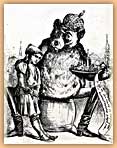
Traditionally, since the 17th century at least, hopes for the liberation of Orthodox Christian populations turned to the blond nation, the Russians. The creation of the independent Greek state was diplomatically based mainly on the support of England; the latter feared Russia would embrace diplomatically the new state.
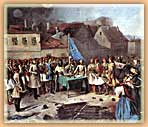
Russian influence was important in the domestic and foreign policy of the newly founded state through the operation of the 'Russian Party'. It was Russia that people supported most consistently and in the greatest numbers, and this became evident when a batallion of volunteers was set up, bearing the title The Legion, in 1855; it participated in the siege of Sebastopol, under Panos Koroneos's leadership, against English and French troops.
The climate in Athens which was in favour of the Russians was characteristically expressed in the articles of Neophytos Vamvas, a professor at the University, and especially Panayiotis Soutsos, the poet. They wrote articles in Athens's Greek newspaper, Eon, which was on the Russian side. Soutsos presented his Russian-friendly, anti-English and anti-Turkish sentiments in two of his books: True Phases of the Eastern Question and Poetic Memoirs on the Eastern War, published in 1853 and 1857 respectively. The latter still exists in its second edition, to which the poet had also added an ode on the coronation of the Russian emperor, Alexander B.
After the Crimean events, the climate was reversed. Traditional anti-Russian tendencies which also existed in Greek political life were reinforced by Russian efforts for panslavic unity. In 1858 the Slavic Philanthropic Society was founded in Moscow and in 1867 the Slavological Ethnographic Exhibition was organized in the same city. At the same time, Bulgarian nationalism began to emerge after the first issue of Slavo-Bulgarian History on Bulgarian Peoples, Kings and Saints, in 1844, written in 1762 by the monk Paisios at Mount Athos.
Inevitably, Bulgarian nationalism was opposed to Greek education which was dominant in the upper classes, and the Patriarchate. The Bulgarians' efforts to improve their position in the internal conflicts of the Patriarchate began in 1860. After Tanzimat, conflicts within the Church had a clearly political and nationalistic character. After an exchange of propositions and plans with the Kapi, the Patriarchate and seceded Bulgarian prelates found themselves in a dilemma. In 1868, Bulgarian bishops declared faith to the Bulgarian Autocephalous Church. In 1870, the Bulgarian Exarchate was founded by a firman of the Sultan, and a bitter struggle began between the Patriarchate and Bulgarian bishops. The Patriarchate condemned 'racialism' and excommunicated its partisans (in favour of Bulgaria) by the Term of 16th September 1872.
Greek foreign policy and public opinion refused to see any parallel course between the national awakening of the Bulgarians and Greek independence at an ecclesiastical, as well as political, level. In fact, when - as a result of the Bulgarian Revolution and the Russian Descent in 1876-78 - the Congress of Berlin declared the independent Principality of Bulgaria, the Greeks saw a menacing opponent claiming territory where solid Greek populations lived. The annexation of Eastern Rumelia to Bulgaria in 1885 left no room for terms of good fellowship.
Since the Congress of Berlin - and for decades afterwards - the Greek liberation policy and the activities of associations and committees was more anti-Bulgarian and anti-Slavic than anti-Ottoman. Russia was, sometimes unjustly, believed to have provoked and orchestrated Bulgarian movements, as the Bulgarians did not, according to many Greeks, fulfil the necessary conditions to be considered an independent state.
Relations between Moscow and the Patriarchates, especially Jerusalem, complicated things. Greeks regarded with suspicion the apparent fondness felt by the Patriarch of Constantinople for Russia; they could neither understand the Patriarchate's ultra-national ideology, nor its close connection to the Tsar. The Greek state did not take into consideration the populations of Pontus which fled to Russian territory, the support of Orthodox pilgrimages to the Holy Land by the Tsar, the intense Slavic presence at Mount Athos or Russia's financial support of monasteries. It demanded that the Patriarchate be aligned with its own foreign policy, as the Trikoupis-Joachim C. conflict showed.
The Slavic world was identified with the Bulgarian threat to Macedonia and Russia was considered to be a heartless protector and friend. The Russian-friendly tendencies of Greek policy did not disappear, but the upcoming Macedonian problem put an end to any hopes of a Balkan coalition of Greeks and Slavs under the benign supervision of Russia.
|
 |


