 |

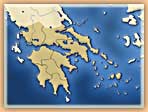
In administrative organization a centralized system which resembled that of the Kapodistrian period was applied. The main objective of the regency was to organize the state apparatus and specifically that of the administration was to marginalize the regional social elites. To bring this about an effort was made by the centre to weaken the influence of the regional power agents. The administration was organized on three levels: prefecture (nomos), county (eparchia) and municipality (demos) according to the decree issued on 3rd-15th April 1833 in the Government Gazette of the Greek Kingdom (the first issue of which was published in Nauplion on 16th-28th February 1833). Throughout the entire kingdom 10 prefectures, 47 counties and 280 municipalities were formed. Both the prefect and the sub-prefect were appointed by the regency which could transfer them to another district or dismiss them. In fact, the regency avoided appointing locals in these positions or keeping someone in the same district for a long period. In this way they attempted to prevent the creation of regional power cells with a degree of independence from the government. The councils of the prefectures and counties, organs which could express politically the views of the local society, never acquired real power. But even on a regional administration scale, the election of a mayor was in reality an appointment because of the system of restricted suffrage which certainly favoured the election of those approved of by the crown. The established centralized system, which also aimed, through the submission of the regional administrative apparatus to the central power, to weaken all the local elites strong enough to contest it, was completed by the multi-fragmentation of the administrative power. In the prefecture the power was shared between eight officials: the prefect, the judge (first instance), the ephor, the treasurer, the Metropolitan, the captain of gendarmerie, the head of the health service and the head of the engineers. Through this separation a great number of regional authorities was created in each prefecture and thus the concentration of powers in a single office was prevented; now one local authority could control the other. Thus, their submission to the central power was facilitated and the interventions - of the palace in the case in question - on local matters was favoured.
|
 |


