 |

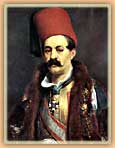
The first elected parliament was formed in January 1845 and appointed I. Kolettis as prime minister. Kolettis formed a government with his allies from the pro-Russian political party. The alliance lasted only a few months but the dominance of Kolettis was maintained until 1847 when he died. Moreover, it was based on the constant support of the crown and the Powers - especially France - as well as on an extensive network of powerful regional factors, most of which were military officers from Rumeli. However, this dominance did not depend only on extra-institutional support. It would be wrong to underestimate the influence of Kolettis over part of the Greek population which saw in him the chief supporter of the Megali Idea, that is the Great Idea, and his unparalleled ability to maintain stability, masterfully handling the crises and de-escalating tensions in a timely fashion. In the period 1844-1847 governmental stability was achieved for the first time; however it was followed by institutional immobility. As far as public safety was concerned, a decline in banditry was observed while the rebellions were eliminated. On the other hand, no progress was made in the production of legislative work. The bills proposed were very few and they revealed the basic concern of preserving stability between the Western-type institutions on the basis of which the Greek state was formed, and an intensely traditional society. The handling of the church question by I. Kolettis which constituted the cause of the rift with the pro-Russian party in the summer of 1845 is indicative. The relevant bill may have attempted to expand the autonomy of the Church out of state control, but no reference was made to the crucial matter of the settlement of relations with the Ecumenical Patriarchate. The recrudescence of I. Kolettis's illness at the end of 1846 gave rise to tensions in the political life of the country. Furthermore, an argument broke out within the pro-French party over a successor for the dying leader, while many deputies joined the opposition which was at that time composed of the pro-Russian party and A. Mavrokordatos. At the same time an alarming increase in the presence and action of groups of bandits was observed, particularly in the frontier districts - a sign of the insecurity which prevailed among the armed men, but also a precursor of an imminent crisis. The reaction of I. Kolettis was to dissolve Parliament (on the approval of the king) on 9th April and to call an election. In these elections, which were held in the summer, Kolettis was once again the winner. However, he died shortly after, on 31st August 1847.
|
 |


