 |

During the 19th century, the importance of prose in literature was inferior to that of poetry. The identification of prose with the stories and legends that were widely consumed by the lower classes, allied to a reserved attitude towards the modern French novel, contributed to a general depreciation of prose. However, as early as the mid-1830s the first steps were being made in the development of Greek literary prose.
The Soutsos brothers once again provided the first impulse following certain translations of European prose. As in poetry, the language of these first prose writings approached katharevousa but it had not yet acquired its definite characteristics; this would only take place later, towards the middle of the century.
Thanos Vlekas (1855) by Pavlos Kalligas (1814-1896) marked a new stage in the course of prose during the 19th century. It is one of the first prose works to refer to the problems of modern life. It comments on banditry, the agricultural question and the impasses into which they had led the social and political life of the country. The Stratiotiki zoi en Elladi (Military life in Greece), the work of an unknown writer published in Braila of Romania in 1870-1871, was along the same lines.
Konstantinos Ramphos, together with Aristotelis Valaoritis, drew themes from the klepht-armatolism of the Ottoman period and the Revolution of 1821. His novels Katsantonis (1862), Ai telephtaiai imerai tou Ali Pasa (The last days of Ali Pasha) (1862) and O Chalet ephentis (1867-1868) are remarkable. Andreas Laskaratos from the Ionian Islands, having made different linguistic choices compared to the Athenian prose writers, offered in addition to his poetic works two significant prose writings: Ta mystiria tis Kephalonias (The mysteries of Cephallonia) (1856) and Idou o anthropos (Here is man) (1886). In the first he confronted the reaction of the Church which led to his excommunication.
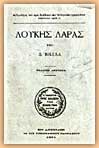
With his historic novel I Papissa Ioanna (Pope Joan), published in 1866, Emmanouil Roidis (1836-1904) also dealt with the reaction of conservative circles and the Church. In 1879 Dimitrios Vikelas (1835-1908) published Loukis Laras, a novel with more personal style and fewer heroic flourishes which could be considered a forerunner of the prose produced by the generation of the 1880s. The period of transition is characterized by the novels To amartima tis mitros mou (The sin of my mother) and Poios iton of phonefs tou adelphou mou (Who was the murderer of my brother) written by Georgios Vizyinos in 1883 and Moskov Selim in 1896. Despite his persistence in the katharevousa, the change in the thematic material can be seen, which paved the way for the naturalistic novel of the New Athenian School.
Later, Drosinis gave his first examples of prose: Agrotikai epistolai (Agricultural letters) (1882), Treis imerai en Tino (Three days on Tinos) (1883), Diigimata kai anamniseis (Stories and memories) (1886) and Amaryllis (1886), while in 1894 Roidis presented the story Psychologia syrianou syzygou (The psychology of a husband from Syros).
Finally, Alexandros Papadiamantis (1815-1911) is a particular type of prose writer. Born in Skiathos, he started with three historical novels: I metanastis (The migrant woman) (1879), Oi emporoi ton ethnon (The merchants of the nations) (1822) and I gyphtopoula (The gypsy woman) (1884). Later he turned to stories, a format he cultivated until his death. The writing of Papadiamantis had a strong religious sentiment. The style, the themes and the language set him apart from the other writers of his generation. He himself cultivated an attitude of withdrawal from the events of the moment and the urgent questions that preoccupied the people of his time.
|

 |


