 |

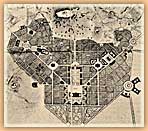
During the period that succeeded the Revolution, a programme of town planning was introduced along with a series of initiatives that would allow the development of modern urban centres. Such initiatives were urgently needed because the wars had seriously damaged both the urban and rural landscape, and besides, the particular character of the towns of the Ottoman period did not easily lend themselves to the imposition of modern town planning. Thus, from the years of Kapodistrias important town planners such as Stamatis Voulgaris from Corfu as well as the engineers of the French military mission undertook to lay out the towns of the Peloponnese (Nauplion, Tripolis, Patra, etc.). With the arrival of Otto, Athens was chosen as the new capital and its development was considered a top priority. This work was carried out by the architects Stamatis Kleanthis and Eduard Schaubert. Their plan emphasised the existing monuments (ancient, Medieval and Ottoman), integrating them functionally with the town while also allowing free space for future excavations, mainly around the Acropolis. As far as the street layout of the new city was concerned, large groups of buildings with wide roads, gardens, squares and free spaces were conceived. The centre of the city would be the area of today's Omonoia where the palaces of the new king were initially intended to be built. The implementation of the plans of Kleanthis and Schaubert was prevented by the property interests of the landlords and the land-grabbers and those who had been lobbying for the exploitation and use of urban space since the Greek state was formed. Although their demands were refuted by their Bavarian colleague Leo von Klenze, the new propositions were never applied. Later plans during the course of the 19th century did not have any great effect on the development of the urban planning of Athens since, following the complete rejection of the initial plans, it was hard to carry out significant developments or reforms in the city. However, the period of the reign of Otto is very important as far as town planning is concerned, as it was during this period that strategy was developed and the pattern of Greek towns was formed. Nevertheless, despite the initial optimism of the late 19th century, town planning initiatives simply expanded to incorporate the layout of city areas which had been built arbitrarily without any previous organisation. It is characteristic that, at its worst, this practice still goes on today.
|
 |


