 |

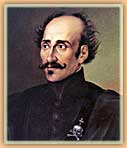
The assumption of leadership by Alexander Ypsilantis is associated with the formation of a plan for the outbreak of the Revolution.
During 1820 the plan was modified many times because the
expansion of the Philiki Etaireia and the recruitment of volunteers had provoked suspicion and some members had been arrested.
Thus, in the beginning of 1821, the Greek Revolution, which seems to have been planned to break out almost at the same time in three different regions - in the Danubian principalities, the Peloponnese and Constantinople - was precipitated.
In the beginning of October 1820 in Izmail, in the Russian region of Bessarabia, members of the Philiki Etaireia met on the initiative of
Alexander Ypsilantis. Among those gathered to define the date of the outbreak of the uprising and to specify the plan were
Emmanouil Xanthos, Chr. Peraivos and Grigorios Dikaios (Papaflessas).
They decided that the Greek Revolution would break out about the end of November/beginning of December in the Peloponnese, where Alexander Ypsilantis would arrive by ship from Trieste. A few days earlier the movement would break out in Moldavia and Wallachia.
This would be a distracting action, predicted to be reinforced by Russia but also by the simultaneous uprising of the Serbs.
Thus, the uprising in the Peloponnese would break out in a period of general revolutionary insurrection throughout the entire Ottoman-ruled Balkans.
The war between Ali Pasha and the sultan's troops, as well as the possibility of another Russo-Ottoman war, added favourably to this planning.
Nevertheless, the outbreak of the Revolution was postponed until the spring of 1821 as the signs from the Peloponnese were discouraging. Later, Alexander Ypsilantis was to lead the movement in the Danubian principalities from where he would cross the Balkan peninsula and reach the Peloponnese. Furthermore, it was predicted that the Greek
navy would stop at Constantinople, set fire to the Ottoman fleet and arrest the sultan in the general chaos provoked in the imperial
capital. Finally, in the middle of February it was decided in Kishinyov, Bessarabia, that Ypsilantis would pass to Moldavia and declare the outbreak of the Greek Revolution on 27 February 1821, the day of the Sunday of Orthodoxy.
The factors that led to the outbreak of the uprising in the Danubian principalities were chiefly dependent on the particular regime of these regions neighbouring with Russia. Moldavia and Wallachia were governed by Phanariotes, who were appointed by the sultan and despite the fact that these regions belonged to the Empire, Ottoman troops could not enter without the approval of Russia.
The very few garrisons were not capable of defending the region, but there was hope that Russia would not allow the entrance of Ottoman troops.
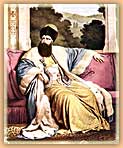
Moreover, Michael Soutsos, a member of the Philiki Etaireia, was Prince of Moldavia and maintained a force of armed men while the leaders of the military forces of Wallachia, Georgakis Olympios and Giannis Pharmakis, came from the Philiki Etaireia as well. Despite the fact that the Greek population was limited, concentrated in towns and occupied in administrative positions, they hoped that they could win over the local populations.
This was the aim of the cooperation with the Vlach revolutionary Vladimirescu, leader of a movement of poor agrarian populations.
None of these hopes came to fruition. The local populations were negative towards a movement in which the Phanariote leaders took part.
The reservation of Vladimirescu, who was in contact with the Ottomans as well, led the members of the Philiki Etaireia to arrest and execute him. Moreover, the hasty preparations and inadequate equipment of the
relatively few Balkan volunteers who composed the army of Ypsilantis
could not make up for their heroism in the battlefield.
Finally, the inaction of the Philiki Etaireia in Constantinople and in particular the condemnation of the movement of Ypsilantis by the Russian Emperor belied even the last hopes for a positive evolution of the movement in the Danubian principalities.
|
 |




