|
||||||||||||||
|
Since the early decades of the 18th
century, the armatoloi had undergone a phase of significant change.
Their origin goes back to the first period of the Ottoman domination of
the Balkan peninsula. Until then the armatoloi constituted a complementary
police force that guarded the inaccessible regions of the Empire. Armed
groups of local Christian protected the mountain passages and dealt with
theft. The armatoloi were officially charged by the central administration
to maintain order in the less well protected regions. In return they were
provided with incentives (tax exempts and privileges). By the beginning
of the 17th century, the number of the armatoloi increased in the
central and south Balkans, with the exception of the Peloponnese. |
|
|||||||||||||
Ferman, firman: edict from the sultan, generally bearing his tughra |
In the middle of the 18th century, vast regions were
under the control of armatoloi groups in Greece. Powerful local
families passed on privileges to their successors. The leading casts developed
close relationships between themselves but also with Christian armed groups.
The traditional conflicts between the armatoloi and klephtes
were gradually replaced by relationships that caused anxiety to the Port
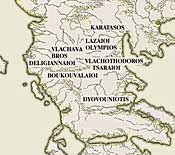
and powerful Muslim officials. Families such as the Lazaioi, Tsariaoi,
Vlachovaioi, Karatasos and Nikotsara symbolized power, resistance and
self-determination in the eyes of the Christian populations of central
Greece. From 1720, when the sultan's firman
abolished many armatolos groups in Thrace and eastern Macedonia, and until
the eve of the Greek Revolution (with the continuous 'liquidations' of
Ali Pasa in western Greece), measures were taken to limit the power of
Christian families. In some cases this led to agreements between the conflicting
parties, but agreements that further complicated the controversy over
control and power. There is no doubt, however, that a century of local
conflict offered the armatoloi valuable experience of war. Some
decades later, they used this experience in the revolution; later on they
became a counterbalancing political force in the newly established Greek
Kingdom. |
|
||||||||||||