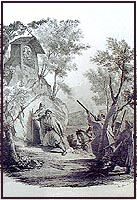
 Ottomans terrorize Greek peasants by shooting at a Christian icon, 1825 |
Atrocities were common occurences under Ottoman rule. Right up to the 18th century, military expeditions signified the beginning of a turbulent and catastrophic period for those living near the routes taken by the Ottoman army. Local populations were forced to contribute goods and cash to help maintain the asker, to do any necessary work for the army and often to watch their houses being destroyed by terrorist attacks. Human life was also subject to random attack, and some were forced to abandon their lands and occupations. In the hunting lands of Thrace and central Greece, peasants' lives were endangered by the activities of the sultan and his hunting companions. Historians and travellers' accounts have reported incidents in which farmers were used as human bait. Sometimes peasants were made to form a fence of human bodies around the prey, and as the hunters closed in, the threatened animals attacked the fence in an effort to escape; but the hunters were at hand to finish off the wounded, both animal and human.
Asker :
the Ottoman army
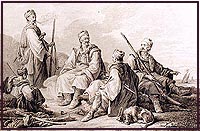 Albanian solders were used to suppress the Revolution of 1770 in the Peloponnese, a notable example of thefts and ravages. |
After the middle of the 17th century, the jannissaries in Constantinople gained control of many industrial activities by the exercise of terror and offers of 'protection' to the guilds. The central authorities tried to solve this problem by expelling them to smaller cities, but as the janissaries had no other income they formed themselves into bands controlled by the dayi. They terrified cities and the rural hinterland with their raids and demands for extra taxes. Their power increased substantially in regions where the local sovereign did not own an army large enough to crush the bands. And so, while the raids of the yamaks, as these armed groups were called, terrorized the inhabitants of the countryside, putting their lives and their fortunes at stake, the people were powerless to protect themselves.
Dayi :
patron