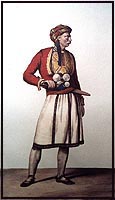
 Albanian, 1825 |
Orthodox Christians belonged to the same millet but without necessarily considering themselves members of the same ethnic group. The abrogation of the Patriarchy of Tirnovo, also known as the 'Church of Bulgaria' in 1390 bred conflicts inside the Orthodox community. The abrogation of the independent Episcopates of Ipekios in 1766 and Achrida in 1767, centres of Serbian and Bulgarian nationality respectively, had the same outcome. Contrary to what historians of the previous century had supposed, the invalidation of these religious and national centres was the result more of economic than nationalistic causes. Since the only educational institutes were Greek, the Episcopates concerned eventually came into the hands of priests of Greek origin or education. So it was that young people, both the laity and the clergy, received a Greek education. It was only natural then for them to follow the next step and serve in the Episcopate, while in many cases the Greek liturgy had replaced the Slavic.
Episcopate Ipekiou:
the independent Episcopate or Patriarchate of Ipekios reestablished in 1557. The Serbian Mohammet Sokollou was recruited, by levy, as an Ottoman official and exercised the duties of Grand Vizier. Sokollou appointed his brother Makario Sokolovitz as first Patriarch of Ipekios
Millet :
group of non-Muslims that formed a legally recognised administrative unit within the state
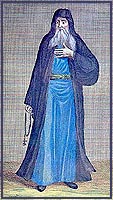 Greek priest, 1715 |
In the 18th and 19th centuries, period of the Enlightenment and nationalism, the expansion of Greek civilization at the expense of Slavonic and Albanian brought inevitable opposition from the non-Greek Christians. The people of the Balkans totally submitted to the Greek element, denounced both the Greek and the Ottoman yokes. The foundation of independent national Churches and their secession from the Patriarchate resolved the issue.