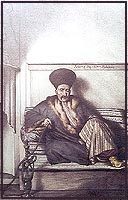
 Ioannis Stamou Chondrodimas or Logothetis, powerful landowner in Leivadia, 1825 |
The Christian populations of the Greek areas under Ottoman dominion were organized into communities whose members would assemble to settle administrative and economic affairs. The prokritoi met annually or sometimes more frequently to elect a leader of communal affairs. Following their final choice there was a ceremony in the main church to which the entire community was invited. During the 17th century, after the Prelatic Service at the Metropolis of Serres, the crowd and the clergy, the 'Great Synod', acclaimed the new leaders and so ratified their election.
Prokritoi
(dimogerondes, kotsabasides, agiannides, proestoi, et al.):
community leaders
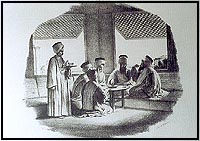 Congregation at the house of voevoda: Athens, 1825 |
On the last Sunday of February, all permanent citizens gathered at the church of Agios Panteleimonas in Monastiraki, Athens, to approve the new leadership. The district-leaders participated in local synods to discuss crucial issues and elect their deligates to the officer of the Gate. The Prokritoi from the Peloponnese assembled to discuss and elect the 'Moria-agiannides', their delegates to the sultan. These assemblies were rife with tension and conflict but offered a new political experience to the Christians living in these areas. They influenced the revolutionary assemblies held during the War of Independence and so powerfully affected the political evolution of the new Greek state.