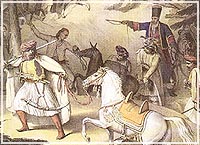
 Caravan in the Pindos Mountains: the leader and an armed companion, 1825 |
During the 18th century, the main roads of the Greek mainland became part of the Balkan trade network. Caravans, large organized commercial expeditions, travelled along these roads from spring to the beginning of winter. Caravan journeys often lasted a year or more, and would include amongst the travelling party emerchants or other trade representatives, muleteers, guides, guards and also pilgrims and priests even travellers from western Europe. The number of people was fixed at the beginning of the journey but usually stood at no more than thirty. Before the journey began there were meetings, arrangements and long drawn-out preparations; and then the caravan would set out from the town's central square. The man in charge of or the organizer of the expedition rode at the front on a pack animal to set the pace. He was followed by guides on horseback (or the 'kiratzides' towards the end of the century) and the pack animals, who carried most of the merchandise. Finally came the travellers who accompanied the long convoy on horse or mule.
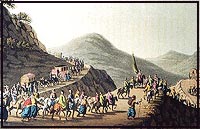 Caravan en route to the Rodopi mountain chain, 1819 |
Prior to the 19th century, mail coaches were not often used for such expeditions. The march continued throughout daylight hours with a few short intervals for rest. Weather permitting, the caravan stayed overnight in the countryside, in a secure area selected by the leader and the guides. A makeshift camp, encircled by animals, was set up to protect the people and the goods. The journey was usually very dangerous so the travellers were permanently armed. They employed guards or settled in places protected by armed groups. There were also specific stopping places, the hanes and the caravanseray where the caravans could stay indoors. The groups and communities of northern Greece built on their experiences gained in the 18th century to expand their economic and social horizons.
Hanes and caravanseray (from the Persian 'chan' meaning house, and 'karban-sarai' meaning caravan yard):
temporary stopping place to allow the caravans some rest. They were built at key points along the empire's road network. Travellers could stay safely overnight, replace their stores and strike deals with local merchants