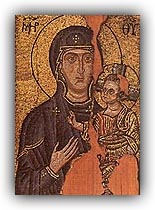
 Komnenoi
are more plentiful than those belonging to the previous period. Stylistically, the masterpieces of this age follow the same styles as monumental painting while at the same time they the miniature artist's tension and sense of luxury.
Komnenoi
are more plentiful than those belonging to the previous period. Stylistically, the masterpieces of this age follow the same styles as monumental painting while at the same time they the miniature artist's tension and sense of luxury.The icons of the Constantinopolitan workshops were renowned for their quality and their sanctity. For this reason, as the Byzantinist Ch. Delvoye mentions, they travelled far. The best known example of such an icon is the Panagia (Virgin) of Vladimir, which was taken to Kiev in around 1130 and is kept today in Moscow. Innovative elements of the composition are the melancholic sweetness characterizing the expression of the Virgin and the tender relationship between the two figures, the Mother and the Child Jesus.
 A great number of icons of this age are kept today in the monastery of St Catherine in Sinai: the icon of the enthroned Virgin holding the Child Jesus and flanked by portraits of prophets (the Kykkotissa type) and the Annunciation are two of the most characteristic examples of the icons of this age.
It was also at this time that the first mosaic icons emerged. The Transfiguration in the Louvre, the two mosaic icons in the Patriarchate of Constantinople and the three icons on Mount Athos (Panagia Hodegetria from the Hilander monastery and the icons of St Demetrios and St George from the Xenophontos Monastery) are the best known examples of this type of icon which was widespread during the Late Byzantine era.
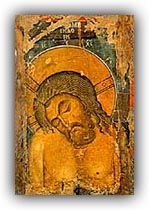
Finally, from the 12th century we have the first examples of diptych icons, that is, icons having a depiction on each side. They were intended to be carried about in processions, as for example the icon of Panagia (Virgin) Hodegetria from Kastoria with the image of the Man of Sorrows on the back, a subject which had not been painted before.