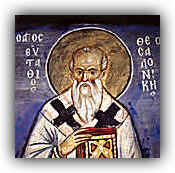
 both for his philological training and his social activities. He was an ecclesiastical official, a scholar and a writer. He was probably born in Constantinople circa 1115 and, after being educated in the Patriarchal School, became a clerk of the future Patriarch Michael III and a monk in the monasteries of St Euphemia and St Phloros. His ecclesiastical career continued with his ordination as deacon, his nomination as a teacher, magistros ton rhetoron (master of the rhetors) after 1166 and epi ton deeseon. Finally he was elected Metropolitan of Thessalonike in about 1178, an office that he held until his death in 1195/6.
He was keen to raise the status of the clergy, and cared for the poor in his social welfare programmes. He inveighed against immorality and illiteracy. In the political field he was supporter of Manuel I Komnenos but did not hesitate, however, to criticize him in certain circumstances. Beyond his deep understanding of political and general issues, as a teacher of grammar, rhetoric and philosophy Eustathios impressed not only with his knowledge but also with his lively command of language. He is mainly known for his literary work; he was also, however, an original thinker and excellent writer. Apart from his literary work, he wrote history, annotations on the work of John of Damascus, encomiastic speeches for the Emperor Manuel I and 74 epistles. In his writings he developed the idea of historical progress from a primordial to a civilized way of life and rejected slavery as a bad and unnatural institution. He enjoyed life and considered human relations more important than the religious ritual. He loved the wealth of the language and often enjoyed complex word games. Lastly, he was interested in people and their everyday activities: the data he cites was published in our own century by the researcher Phaidon Koukoules.