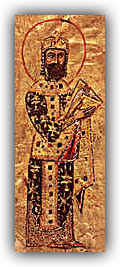
 of Alexios I Komnenos (1081-1118), an Emperor who was personally interested in many dogmatic issues. From the first days of his reign Alexios I had to deal with several heretical teachings, of which those of John Italos and the Bogomils stand out.
 The successor of Michael Psellos in the office of hypatos ton philosophon at the University of Constantinople, John Italos, was influenced by the works of Aristotle, Plato and the Neoplatonic school. He began to teach things not always in line with the doctrines of the Church. He was accused of several heresies and indicted in 1082 in an ecclesiastical court, where his teaching was condemned and he was anathematized.
The Bogomils were upholders of Paulikian teaching, that had prevailed in Bulgaria since the 10th century, but they had gradually started to spread their teaching into Byzantine lands. The spread of Bogomilism alarmed Alexios I and he ordered the arrest of their leader, Basil. After a synodal decision he was condemned to death by burning at the stake (about 1110). The persecution of the Bogomils by Alexios I put a stop to the spread of their doctrines within Byzantine Empire. The heresy, however, survived in Bulgaria up to the Turkish conquest.
Manuel I Komnenos also had to deal with theological issues, for instance, with the question as to whether the Eucharist should be offered only to the Father or to the Holy Trinity.