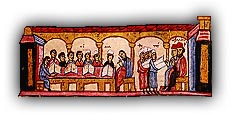
 in relation to that of the tenth. Most educational institutions mentioned in the sources were directly linked with the Church. A change took place in the teaching programme with the introduction of the schedographia by Michael Psellos. In schedographia students had to copy a text exactly and then analyse it grammatically, stylistically and historically.
 A very important event in the development of education in the 11th century was the foundation by Constantine IX Monomachos (1042-1054) of two schools. These were the schools of Law and Philosophy. Those who attended these schools of higher education were supposed to assume some kind of higher state office or to get involved with legal matters. Thus the state Didaskaleion Nomon (School of Laws) was established. The school had its own library and no fees were demanded. We know that the professors had to speak Greek and Latin and to teach to the students not only law but also ethics and rhetoric. The holder of the office of nomophylakas, that is the Law School's Director, was paid in gold, silk clothes and foodstuffs. The first nomophylakas later became the Patriarch John VIII Xiphilinos. The School of Philosophy was founded on the instruction of Michael Psellos. Psellos himself taught philosophy and from 1045 held the title of proedros (president) or hypatos ton philosophon, Director of the School. The holder of this office had most probably as part of his responsibility to oversee all the state educational institutions of the capital and to allocate a sum of money corresponding to the needs of each. The successor to Psellos in the office of the hypatos ton philosophon was his student, John Italos.