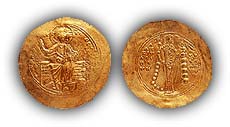
 At the same time, the minting of silver coins had almost stopped, while the copper folles were struck sparingly.
In 1092 he Emperor Alexios I Komnenos took drastic measures and reformed the Byzantine monetary system for the first time. He issued a completely new series of scyphate (cupped shaped) coins: the golden hyperpyron and the aspron trachy (white, uneven) made of electron (1/3 of a hyperpyron in value), and the aspron trachy made of billon (1/48 of a hyperpyron). The histamenon, the tetarteron and the miliaresion of the previous period continued to circulate. The tetarteron, however, was changed into a small, thick copper coin in order to create a smaller denomination coin. Like the folles of former times, it was in turn to disappear: the latter tetartera, extremely small in size, circulated in the days of Manuel Komnenos (1143-1180).
The new system ran through the 12th century, with one addition, that of the half tetarteron in the reign of John II (1118-43). The two aspra trachea, however, were significantly debased. The trachy made of billon was reduced by the end of the century to the 1/184! of the value of the hyperpyron (thanks to a progressive reduction in the silver content of its alloy which at the beginning was at least 60%), while that made of electrum was debased in the reign of Isaac II (1185-95) to such a degree that it did not survived through to the Late Byzantine era.