From 843 onwards, architecture was dominated by the type of the cross-in-square church, which was developed gradually
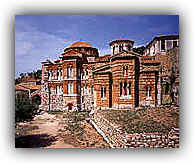 in the iconoclastic period, and appears in four
basic variations. In this period churches were built in the architectural style of the basilica,
the free cross, single-naved, triconch or tetraconch.
in the iconoclastic period, and appears in four
basic variations. In this period churches were built in the architectural style of the basilica,
the free cross, single-naved, triconch or tetraconch.
The ascension of Basil I to the throne in 867 saw the erection of new churches as well as
the renovation of many older ones. At the same time private initiatives appeared on the part
of the aristocratic class, which had started to become stronger.
A basic feature of this period is the differentiation of churches due to the materials used, in the
way they were structured, their decoration and its architectural type. Thereby,
Constantinople and the regions directly affected by it - Macedonia, Thrace, the seacoast of
Asia Minor and a few islands such as Chios represent the school of Constantinople.
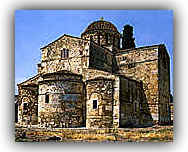 On the other hand, the rest of the continental and insular Helladic territory constitutes the Helladic
school.
On the other hand, the rest of the continental and insular Helladic territory constitutes the Helladic
school.
The most usual architectural type of the school of Constantinople is the one of the
complex four-columned inscribed. The churches were built using alternate layers of chiselled
stones and bricks. In a few churches of the Capital, however, the unalloyed brick-masonry was applied,
an extremely expensive mode of construction. As for the Helladic school its dominant architectural type was the simple four-columned along with the two-columned one. The outer structure was built using the cloisonne masonry, namely in zones of isodome stones surrounded by bricks while the surfaces were decorated with ceramoplastic jewelry.
The majority, however, of the churches representing the two schools were built in the 11th
century and constituted a subject of more analytic development in the period 1025-1081.