The Agios
Stephanos,
Taxiarches
Metropoleos and
Panagia
Koumpelidiki
churches were
founded at
Kastoria in the
mid-10th century.
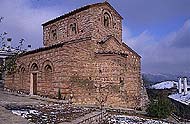 The Agioi Anargyroi church is
thought by scholars to have been built not long
after these, at about the turn of the 10th century.
The Agioi Anargyroi church is
thought by scholars to have been built not long
after these, at about the turn of the 10th century.
All four buildings have architectural features in common - for instance, external decorative brickwork, and ground plan - showing that they were all put up by a local building workshop.
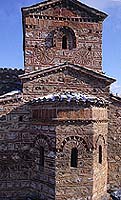
Specifically, all (except for Koumpelidiki, a domed triconch church) are small Eastern three-aisled basilica churches, with the centre aisle roof substantially loftier than the side aisles. A particularly rich fund of decorative brickwork is drawn upon for the church's external embellishment. Bricks are embedded in the building's plaster so as to form suns, herringbone patterns, Greek alphabet letters, or friezes of opus reticulatum. These churches' striking similarities of external decoration and architectural plan support the inference that there was a building workshop hard at work in Kastoria during this period.
The Agioi Anargyroi church on the slope of the hill outside the walls of the Byzantine town was built not much later. This too is a three-aisled basilica church with lofty nave roof, linked by its architectural plan with the group of three churches mentioned earlier. These similarities can hardly have been accidental, and they show that the workshop had a tradition which continued for about fifty years.
The above text belongs to the electronic pages entitled Byzantine Kastoria. Click the image next to this text to view the corresponding presentation. |
|
