|

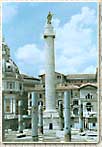
One of the most representative historical reliefs in Roman art is Trajan's Column
at Rome, in Trajan's Forum. A relief frieze spiralling round the column, it shows
the events of the emperor's campaigns against the Dacians, in 101-2 A.D.
and 105-7 A.D. in a continuous bas-relief with perspective rendering. Some scholars believe that the model for the way in which the two
campaigns are conceived on a continuous relief can be traced to the late
Hellenistic period - a representative example being the Telephus frieze of
the altar at Pergamum.



The frieze of the altar of Domitius Ahenobarbus at Rome (107 B.C.),
which probably originates from a temple of Poseidon. One side shows
the wedding of Poseidon and Amphitrite, escorted by Nereids and Tritons, while
the other shows the Roman stock-taking ritual called lustrum, involving
the sacrifice of a pig, a sheep, and an ox (the suovetaurilia). Thus two
pictures of different technique coexist on one and the same monument, yoking a
Hellenic mythological theme with a Roman historical narrative. This is typical
of the period.
|