The political imposition of Rome into Greece started at the end of the 3rd century BC and was realized during three wars over a period of half a century, which made it initially a rival of Macedonia and, gradually, the rest of the Greek world.
During the 1st Macedonian War (215-205 BC), the Romans, and their allies the Aetolians, came into conflict with the king of Macedonia, Philip V, and the cities of central Greece, which the latter had taken. In diplomacy, during the late period of the Hellenistic history, the alliance of the Macedonian king with the Carthaginian Hannibal, an implacable enemy of the Romans, is a very interesting occurence.
At the beginning of the 3rd century BC, and after the 2nd Macedonian war, the Romans defeated Philip V of Macedonia (200-197 BC) and Antiochus III of Syria (191-189 BC). This prevented the former from exercising his control on central Greece and forced the latter to abandon all his occupations in Asia Minor.
After the end of the 3rd Macedonian war (171-168 BC), Rome completely defeated the power of Macedonia and placed Syria and Egypt among the sphere of its influence. It is to precisely this period that Polybius dated the establishment of the Roman occupation in Greece and the end of the independence of the Greek east.
| introduction |
Alexander |
successors |
kingdoms |
Greece |
freedom |
Note: Click on the small photo to enlarge it.
|
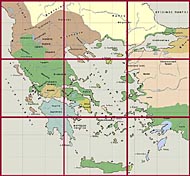
01. Map of Greece and Asia Minor after the end of the 3rd Macedonian war. It was then that the kingdom of Macedonia was abolished, divided into four autonomous "districts", and had to pay homage to Rome.
For the rest of Greece, Rome exercised the policy of abolishing the various powers by creating new Koina.  |
