After the battle of Ipsus (301 BC) the Diadochi (Successors) proceeded in terrestrial realignments, of which the most important were the following: from 294 BC Demetrius I 'Poliorcetes' became king of Macedon, under the authority of which came most of central Greece and the Aegean islands. The domination of Ptolemy I expanded to the cities of Phoenicia and Cyprus, that of Seleucus I to Cilicia and Mesopotamia, while the effort of occupying Coele ('Hollow') Syria during the 3rd century BC, provoked a new series of military conflicts between the Ptolemies and the Seleucids. In around 300 BC, the kingdom of Pontus was established by Mithridates I, from a coastal district that he himself abstracted from north Cappadocia. At the same time, after the battle in Corupedium (281 BC) the collapse of Lysimachus' state -which expanded around the Hellespont- had negative consequences for the Greek world, as it left its northern borders exposed to posterior Galatian raids.
The new generation of Hellenistic monarchs, most of whom were sons of the successors of Alexander, and who resumed power at the end of the 4th and beginning of the 3rd centuries BC, were called Epigoni. The rulers who distinguished themselves were Ptolemy II Philadelphus ('Sister-loving') in Egypt, Antiochus I (Soter) in the kingdom of the Seleucids and Antigonus 'Gonatas' in the kingdom of Macedonia.
| introduction |
Alexander |
successors |
kingdoms |
Greece |
freedom |
Note: Click on the small photo to enlarge it.
|
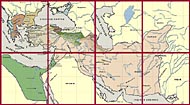
01. The Hellenistic states were formed around 290 BC.  |
