
Hellenistic architecture is characterized by monumental facades of sites and buildings, such as city gates, market propyleae (entrances) and sanctuaries, theatre scenes and entrances of funerary monuments. A special characteristic of these structures is that both their dimensions and decoration are formed independently from the architectural type of the buildings they frame or to which they belong.
At the same time, the use of barrel-vaulting and the arch for the roofing of the buildings, doors or gates is generalised during Hellenistic times, especially in Macedonia and Asia Minor.
Stoas are connected to the political and intellectual life and thought of the time. During the Hellenistic period, the stoas are constructed wider, whilst the partitions added to the rear created the appropriate areas used as shops, storehouses, public offices or even libraries. Another, more developed type of stoa -which is especially met in cities of Asia Minor- known as pergamenos, included temples, sanctuary precincts, even whole agoras, thus creating quadrilateral open areas.
During Hellenistic times, the theatre was developed both in architectural structuring and functional suitability. Compared to similar classical theatres, the orchestra was reduced, whilst the stage acquired monumental dimensions and bore colonnades, door-frames, arches, pediments and an elaborate decoration on its facade. During the dramatic plays, the role of the chorus was limited and the action of the actors was shifted to the elegeio (on the podium above the proscenium) thus creating the episcenium, that is the second floor of the stage. At the same time, the theatre ceased to form a part of Dionysus' sanctuary and became one of the most important buildings of political life.
| introduction | language | religion | poetry-literature |
| philosophy-sciences | architecture | sculpture | arts |
Note: Click on the small photo to enlarge it.
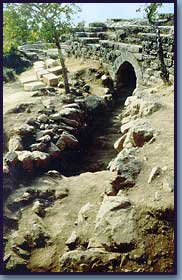
01. The Ptolemaeio in Samothrace. This is the propylon of the sanctuary of Great gods, which was dedicated by

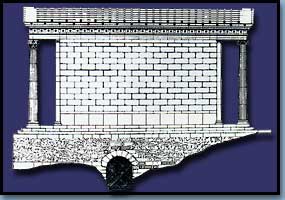
02. Drawing of the side view of the Ptolemaeio
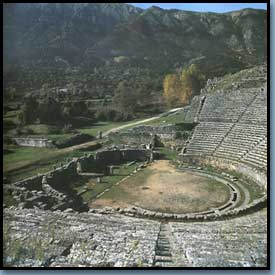
03. The theatre of Dodona. It was built in the 3rd century BC, during the reign of Pyrrhus, and had a capacity of about 17,000 people.