| Slaves formed part of the property of private individuals. They were members of the
household and, as a result (with the exception of production processes where they were used
in household and farming occupations), participated in the consumption of goods and
family celebrations. Their usual source of origin was war
and piracy.
The children of slaves remained slaves, in contrast to the offspring of free men and
slave women who were free men. In the Homeric poems, slaves are implied by more
specific names determining either their origin from war booty or their position
and occupation in the household: oikeus (household
slave), amphipolos (female servant), tamie (house-keeper), thalamipolos.
|
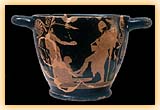 The
position of a slave could, in practice, considerably vary within the framework
of the household. The case of the slaves who belonged to the household of Odysseus is characteristic.
Even though the majority were destined to execute the orders given,
there was a privileged group who enjoyed the confidence and esteem
of their lords and participated in the management of the household.
Eumaeus, for example, belonged to this latter class, and he had been allotted, not only a plot of
land and a wife, but he had also acquired a slave of his own.
His position could be considered to be superior even to that of certain free men,
such as thetes. The
position of a slave could, in practice, considerably vary within the framework
of the household. The case of the slaves who belonged to the household of Odysseus is characteristic.
Even though the majority were destined to execute the orders given,
there was a privileged group who enjoyed the confidence and esteem
of their lords and participated in the management of the household.
Eumaeus, for example, belonged to this latter class, and he had been allotted, not only a plot of
land and a wife, but he had also acquired a slave of his own.
His position could be considered to be superior even to that of certain free men,
such as thetes. |
