
The craftsman par excellence in the Homeric poems, the god Hephaestus, is a bronzesmith. His workshop, situated next to his residence on Olympus, is a typical example of one used for working copper, iron and also gold.
 Traces
of metalworking activities have been preserved in various areas both in
Greece and areas where Greek colonists have settled. In Argos, a kiln used for the extraction of
silver has been located, dating to the early Protogeometric period. Excavations
at Thoricus in southern Attica unearthed a large area equipped with stone
benches and many basins cut into the floor, and demonstrated that already
from the 9th century BC the working of silver -from the adjacent
mines of Laurion- was known.
In two of these basins a substance known as litharge was found, this is the
residue of lead after the extraction of silver by means of cupellation. The remains of clay moulds
for the manufacture of tripods found in Lefkandi show that bronzesmiths' forges
must have existed there since the late 10th century approximately. Remains of
ironworking were found in various spots, close to the wall of Zagora on Andros for instance,
and denote the existence of ironworking forges within a fortified city.
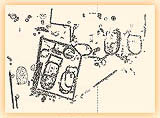
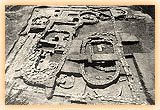
Still more impressive are the metalworking installations of the 8th century
BC, excavated in the area of Mezzavia in Pithecussae. They include two
workshops of bronze-, iron- and leadworking along with their kilns, as well as
an adjoining room serving as a dwelling.
Traces
of metalworking activities have been preserved in various areas both in
Greece and areas where Greek colonists have settled. In Argos, a kiln used for the extraction of
silver has been located, dating to the early Protogeometric period. Excavations
at Thoricus in southern Attica unearthed a large area equipped with stone
benches and many basins cut into the floor, and demonstrated that already
from the 9th century BC the working of silver -from the adjacent
mines of Laurion- was known.
In two of these basins a substance known as litharge was found, this is the
residue of lead after the extraction of silver by means of cupellation. The remains of clay moulds
for the manufacture of tripods found in Lefkandi show that bronzesmiths' forges
must have existed there since the late 10th century approximately. Remains of
ironworking were found in various spots, close to the wall of Zagora on Andros for instance,
and denote the existence of ironworking forges within a fortified city.
Still more impressive are the metalworking installations of the 8th century
BC, excavated in the area of Mezzavia in Pithecussae. They include two
workshops of bronze-, iron- and leadworking along with their kilns, as well as
an adjoining room serving as a dwelling. 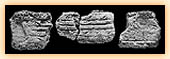 The
two major ways of manufacturing metal objects were smelting molten
alloy to an appropriately formed mould, and hammering. In their final decoration, apart
from incision which was usually used for rendering details, the technique of repousse
was applied, in which stone moulds were used for the imprint of pictorial motifs
on metal bands. In certain cases, the moulds of a certain workshop may have originated
from other workshop centres of the period, for this reason the style of the
representations on its products may present basic differences. For instance,
it is likely that the stone mould used for the decoration of a gold diadem in
a workshop of Eretria at the end of the 8th century BC originated
in Attica.
The
two major ways of manufacturing metal objects were smelting molten
alloy to an appropriately formed mould, and hammering. In their final decoration, apart
from incision which was usually used for rendering details, the technique of repousse
was applied, in which stone moulds were used for the imprint of pictorial motifs
on metal bands. In certain cases, the moulds of a certain workshop may have originated
from other workshop centres of the period, for this reason the style of the
representations on its products may present basic differences. For instance,
it is likely that the stone mould used for the decoration of a gold diadem in
a workshop of Eretria at the end of the 8th century BC originated
in Attica. 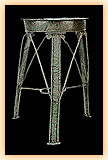 Works of metallurgy
are often a reliable evidence of prosperity, that may be due either to
wealth derived from internal sources, or to successful commercial exchange. One of the elements that prove
the growth of the art of metallurgy and betray the wealth that
begins to accumulate within Greek cities due to the systematic contacts
with the East, is the manufacture of large bronze tripods.
These vessels, before the end of the 9th century BC, are almost exclusively encountered
in burials, while from the Late Geometric period onwards they are found in their majority
in sanctuaries as votive offerings. It thus becomes evident that from the 8th century BC,
gods get a larger share in the existing wealth. It is not irrelevant
that metal workshops are frequently found in public spaces or in direct
contact with sanctuaries. The relationship between workshops and sanctuaries has been
verified through excavations in Enkomi on Cyprus, abandoned in the 11th century BC, and during
the Geometric period in Olympia, Oropus, Tegea and Eretria.
Works of metallurgy
are often a reliable evidence of prosperity, that may be due either to
wealth derived from internal sources, or to successful commercial exchange. One of the elements that prove
the growth of the art of metallurgy and betray the wealth that
begins to accumulate within Greek cities due to the systematic contacts
with the East, is the manufacture of large bronze tripods.
These vessels, before the end of the 9th century BC, are almost exclusively encountered
in burials, while from the Late Geometric period onwards they are found in their majority
in sanctuaries as votive offerings. It thus becomes evident that from the 8th century BC,
gods get a larger share in the existing wealth. It is not irrelevant
that metal workshops are frequently found in public spaces or in direct
contact with sanctuaries. The relationship between workshops and sanctuaries has been
verified through excavations in Enkomi on Cyprus, abandoned in the 11th century BC, and during
the Geometric period in Olympia, Oropus, Tegea and Eretria.