 |
| During the Dark Age, contacts between Greece and the West had declined.
Yet, from around the end of the 9th century BC, pottery finds provide
evidence of frequent communications with Etruria. Euboean traders had,
from the first quarter of the 8th century BC, already penetrated into the Tyrrhenian
sea and had developed trade contacts with the inhabitants of Etruria and Campania.
These areas were particularly attractive for their natural wealth in ores of
copper, lead and particularly iron. |
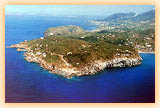 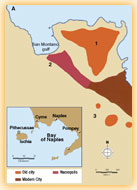 Euboeans
who, according to an ancient tradition, came both from Chalcis and Eretria, founded
their first permanent outpost on Ischia, a volcanic island close to the entrance
of the bay of Naples. The colony at Pithecussae was situated at the northwestern
end of the island on a fortified site, with the cape of Monte di Vico as its citadel.
The cemetery was at the adjoining Vale San Montano and beyond that there was a
significant early settlement on the Mezzavia ridge. Euboeans
who, according to an ancient tradition, came both from Chalcis and Eretria, founded
their first permanent outpost on Ischia, a volcanic island close to the entrance
of the bay of Naples. The colony at Pithecussae was situated at the northwestern
end of the island on a fortified site, with the cape of Monte di Vico as its citadel.
The cemetery was at the adjoining Vale San Montano and beyond that there was a
significant early settlement on the Mezzavia ridge. |
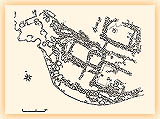 Pithecussae held a strategic position for the trade with Etruria and Campania
and had the character of an international trade station. Abundant remains of metalworking,
such as slags, lumps of iron and horn-shaped bellows,
found both at Mezzavia and Monte di Vico, testify to the existence of active
metal workshops and prove that metal trade was a profitable enterprise for the
inhabitants. The traders of Pithecussae were, according to studies carried out, obtaining iron ore
from the isle of Elba, and copper and silver from the ore-rich areas
of northern Etruria. The wide geographical spread of Greek or hellenizing pottery is the major indication for
these activities. From Etruria they were buying ores and supplying
oriental trinkets as well as their knowledge of metalworking in return. From the imports
and imitations of Greek pottery in areas of southern Etruria,
and their absence from northern Etruria, it becomes evident that the people of
Pithecussae acquired their metals through the markets of southern Etruria and
must not have had direct access to metal mines.
Pithecussae held a strategic position for the trade with Etruria and Campania
and had the character of an international trade station. Abundant remains of metalworking,
such as slags, lumps of iron and horn-shaped bellows,
found both at Mezzavia and Monte di Vico, testify to the existence of active
metal workshops and prove that metal trade was a profitable enterprise for the
inhabitants. The traders of Pithecussae were, according to studies carried out, obtaining iron ore
from the isle of Elba, and copper and silver from the ore-rich areas
of northern Etruria. The wide geographical spread of Greek or hellenizing pottery is the major indication for
these activities. From Etruria they were buying ores and supplying
oriental trinkets as well as their knowledge of metalworking in return. From the imports
and imitations of Greek pottery in areas of southern Etruria,
and their absence from northern Etruria, it becomes evident that the people of
Pithecussae acquired their metals through the markets of southern Etruria and
must not have had direct access to metal mines. |
| The colony reached its height toward the end of the 8th century BC. Nevertheless,
tough competition which broke out in the same period in Euboea between Eretria and
Chalcis resulted, according to Strabo, in a conflict between the Chalcideans and Eretrians
of the colony, which ended in the departure of the latter. According to the same
author, the island was later abandoned after a volcanic eruption and
earthquakes. |