 |
| During the Dark Age, for almost a century all manner of communication with
the East seems to have been interrupted. As a consequence, all products
from imported precious materials were absent. The source of ivory was
Syria where, according to experts, there were still wild elephants.
The first specimens of ivories, after the end of the Mycenaean world,
are a duck statuette and a seal from the Kerameikos dating to the mid-9th
and the early 8th centuries BC respectively.
|
| The two almost intact naked female figurines found in the Dipylon along
with fragments of three others are of greater significance. The two better preserved
depict figures with a polos on their heads and their arms glued
to their thighs. Their anatomical details are more naturalistic than in their
contemporary bronze figurines, a fact partially owing to the qualities of
ivory. This material, like wood, allows its even carving as well as the rendering
of plasticity and mass.
|
|
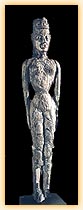
The figures from the Dipylon have been identified as deities and most researchers parallel them
with similar figures of ivory, widespread in Syria and Phoenicia during
the 9th and 8th centuries BC. Similarities are conspicuous with figurines of the
goddess Ishtar or Astarte from Nimrud, manufactured in the northern Syrian kingdom
of Hama until c. 720 BC and imported to Rhodes and Crete. The figurines
of the Dipylon, however, are works of Greek craftsmen (maybe Ionians),
who adjusted the plump oriental models in the Greek Geometric idiom and used
Greek motifs exclusively in the details, such as the maeander and chevron.
|
| Ivory miniature sculpture flourished in the following centuries (7th and 6th BC) especially
in Ionia and Sparta. Excavations have brought to light exceptional specimens from
Ephesus, Erythrae, Samos, Sparta, Perachora and Delphi. |