
 Protogeometric,
1050-900 BC. The Protogeometric Attic pottery seems to be a continuation of the
sub-Mycenaean as far as form and decoration are concerned. The most representative group of
Protogeometric vases comes from the Kerameikos cemetery. It includes
necked amphorae, stamnoi, hydrias, lekythoi, trefoil-mouthed oinochoe,
kalathoi reminiscent of wicker baskets, pyxides, skyphoi, kantharoi and cups. More rarely, animal-shaped vases
in the form of ducks or deer appear and are probably a Cypriot influence. Concentric
semicircles and circles, linear and 'chequered' motifs are the most common decoration.
At the same time, the first specimens of pictorial decoration emerge. Towards the end of the Protogeometric
phase, a large part of the surface of the pot was covered by a dark glaze, a method which
was to be continued during the subsequent phase; the Early Geometric.
Protogeometric,
1050-900 BC. The Protogeometric Attic pottery seems to be a continuation of the
sub-Mycenaean as far as form and decoration are concerned. The most representative group of
Protogeometric vases comes from the Kerameikos cemetery. It includes
necked amphorae, stamnoi, hydrias, lekythoi, trefoil-mouthed oinochoe,
kalathoi reminiscent of wicker baskets, pyxides, skyphoi, kantharoi and cups. More rarely, animal-shaped vases
in the form of ducks or deer appear and are probably a Cypriot influence. Concentric
semicircles and circles, linear and 'chequered' motifs are the most common decoration.
At the same time, the first specimens of pictorial decoration emerge. Towards the end of the Protogeometric
phase, a large part of the surface of the pot was covered by a dark glaze, a method which
was to be continued during the subsequent phase; the Early Geometric.
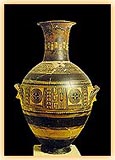
Early Geometric, 900-850 BC. In this phase, drawings with compass are abandoned
and compositions with zig-zags, curved lines and maeanders are opted for. In certain cases,
the motifs are presented inside a frame. The most common shapes to be found are
kraters, stemless skyphoi and pyxides with a pointed base, intended for hanging.
Middle Geometric, 850-760 BC. The surface of vases during this phase is divided into several zones and decorated with batches of parallel lines. As a decoration motif, the maeander is still in use, while hooks and the combinations of rows of triangles and lozenges emerges. Among the new vase types, the krater with the additional support member between the handle and the rim, the oinochoe with flaring neck and the flat pyxis with a wheel-made handle on the lid, stand out. Sometimes, in place of this handle, one to four small horses are encountered. The figures of men and animals are still quite rare (small horses, deer, pigs, battle scenes and a female mourner).
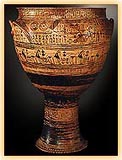 Late
Geometric, 760-700 BC. The pottery of this phase is influenced by significant changes
in the demographic and economic data of Attica. Most vases originate once more from cemeteries such as
those of the Kerameikos, Thoricos, Eleusis and Myrhinnous. Many of them are of vast dimensions
and have been used as grave markers. Necked amphorae and kraters are common
in male tombs, whilst stamnoi are more prevalent in female ones. Pictorial representations
cover a larger part of the surface of the vase, gradually replacing supplementary
ornaments. For the first time we are in a position to distinguish the style of specific
vase painters, such as the 'Dipylon painter' and the 'Hirschfeld painter'.
They are prominent mostly in the decoration of large grave vases, which usually bear
scenes of the prothesis
and the
ekphora. Other common subject-matter of the Late Geometric Attic pottery
are warriors, battle scenes, horses and, more rarely, other animals.
Open conical cups, bowls, kotylai and kraters with a high perforated base were added to the styles already in use. The aforementioned painters
led Geometric vase painting to its culmination, displaying at the same time
its limitations and conventionality. The relaxation of Geometric austerity
came about with the break represented, both in subject matter and style, by the Protoattic pottery.
Late
Geometric, 760-700 BC. The pottery of this phase is influenced by significant changes
in the demographic and economic data of Attica. Most vases originate once more from cemeteries such as
those of the Kerameikos, Thoricos, Eleusis and Myrhinnous. Many of them are of vast dimensions
and have been used as grave markers. Necked amphorae and kraters are common
in male tombs, whilst stamnoi are more prevalent in female ones. Pictorial representations
cover a larger part of the surface of the vase, gradually replacing supplementary
ornaments. For the first time we are in a position to distinguish the style of specific
vase painters, such as the 'Dipylon painter' and the 'Hirschfeld painter'.
They are prominent mostly in the decoration of large grave vases, which usually bear
scenes of the prothesis
and the
ekphora. Other common subject-matter of the Late Geometric Attic pottery
are warriors, battle scenes, horses and, more rarely, other animals.
Open conical cups, bowls, kotylai and kraters with a high perforated base were added to the styles already in use. The aforementioned painters
led Geometric vase painting to its culmination, displaying at the same time
its limitations and conventionality. The relaxation of Geometric austerity
came about with the break represented, both in subject matter and style, by the Protoattic pottery.
|
|
|
| |
|
Note: Click on the icons to read a brief description. |
|