 |
 The
end of the Mycenaean world also signalled the end of the arts with high technical requirements.
Large sculpture, which had flourished in the service of the palace system, collapsed along with it.
Throughout the Dark Age, the morphological language of representing people and animals
appears extremely limited and the only finds we have for its study are few and cursorily
made works of terracotta figurines. The production of bronze figurines began around
900 BC and flourished throughout the 8th century BC. Their study led to distinguishing groups
with common stylistic features, connected to specific
production centres and their relation with the subsequent large sculpture works
of these areas was established. The distinctions among bronze workshops are neither
always verified, nor absolutely clear. Their evidence, however, remains
exceptionally significant, especially for cities and areas which are not mentioned
in written sources. The
end of the Mycenaean world also signalled the end of the arts with high technical requirements.
Large sculpture, which had flourished in the service of the palace system, collapsed along with it.
Throughout the Dark Age, the morphological language of representing people and animals
appears extremely limited and the only finds we have for its study are few and cursorily
made works of terracotta figurines. The production of bronze figurines began around
900 BC and flourished throughout the 8th century BC. Their study led to distinguishing groups
with common stylistic features, connected to specific
production centres and their relation with the subsequent large sculpture works
of these areas was established. The distinctions among bronze workshops are neither
always verified, nor absolutely clear. Their evidence, however, remains
exceptionally significant, especially for cities and areas which are not mentioned
in written sources. |
 Most
of these statuettes were votive offerings in local sanctuaries (Athens, Argos, Samos)
or panhellenic ones (Olympia, Delphi, Dodona). Human figures appear very schematic
and any identification would be rather arbitrary. This, however, did not prevent certain scholars
from identifying a couple of Zeus and Hera and a group of Heracles and Nessos, both
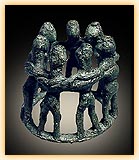
originating from Olympia. Different interpretations have been given for a group
of men holding each other by the shoulders in a circular arrangement, found in the same sanctuary.
Some consider them "dancers", whilst others see them as "men crushing grapes".
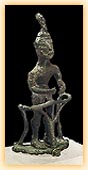
Figures of naked warriors brandishing spears are quite frequent
(Olympia, Dodona, Acropolis). The one found at Karditsa bears the characteristic
'figure-of-eight' or 'Dipylon' shield. Some of these statuettes were intended
for the decoration of lebetes (cauldrons) or other large open vessels. Lastly, it is interesting to note that from quite early on, bronzesmiths represented
their own work: there are a few figurines depicting men manufacturing
weapons. Most
of these statuettes were votive offerings in local sanctuaries (Athens, Argos, Samos)
or panhellenic ones (Olympia, Delphi, Dodona). Human figures appear very schematic
and any identification would be rather arbitrary. This, however, did not prevent certain scholars
from identifying a couple of Zeus and Hera and a group of Heracles and Nessos, both
originating from Olympia. Different interpretations have been given for a group
of men holding each other by the shoulders in a circular arrangement, found in the same sanctuary.
Some consider them "dancers", whilst others see them as "men crushing grapes".
Figures of naked warriors brandishing spears are quite frequent
(Olympia, Dodona, Acropolis). The one found at Karditsa bears the characteristic
'figure-of-eight' or 'Dipylon' shield. Some of these statuettes were intended
for the decoration of lebetes (cauldrons) or other large open vessels. Lastly, it is interesting to note that from quite early on, bronzesmiths represented
their own work: there are a few figurines depicting men manufacturing
weapons. |
 Among
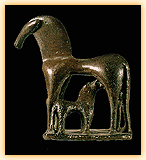
the more popular animals were small horses and birds, while deer appear more rarely.
They usually rest on a perforated base or a plaque with Geometric incisions on the
lower part. Several small horses have been found, which enable us to distinguish
local schools, among which the most important were the Laconian, Argolian, Corinthian
and Thessalian. From a technical point of view, all statuettes are solid
and cast in a mould. Towards the end of the Geometric period the incised details
increased and natural proportions began to prevail in the rendering of the
body. At the same time, the first inscriptions identifying the name of the dedicator emerge. Among
the more popular animals were small horses and birds, while deer appear more rarely.
They usually rest on a perforated base or a plaque with Geometric incisions on the
lower part. Several small horses have been found, which enable us to distinguish
local schools, among which the most important were the Laconian, Argolian, Corinthian
and Thessalian. From a technical point of view, all statuettes are solid
and cast in a mould. Towards the end of the Geometric period the incised details
increased and natural proportions began to prevail in the rendering of the
body. At the same time, the first inscriptions identifying the name of the dedicator emerge. |