 |
||
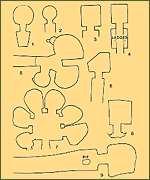
The chamber tombs are subterranean rooms hewn out of hill sides which were used for many successive burials. They constitute the most widespread grave type of the Mycenaean period. This type appeared during the Late Helladic II and continued until the Late Helladic III C period. Nevertheless, the greatest number and the most typical chamber tombs belong to the Late Helladic IIIA-B period. The chamber tombs may resulted from the mixing of elements from the cist graves and the shaft graves of the early Mycenaean period while they may also have come from the Cyclades where these existed in a similar form from the Early Bronze Age. Many differences are observed in the shape and the quality of their construction. The area of the chamber reaches usually about 7m2 and its shape which was sometimes four-sided or ellipsoid or horse-shoe-shaped depended on the quality and the hardness of the soil. The largest chamber tomb is the so-called "tomb of the children of Oedipus" at Thebes which had been decorated with paintings. A long and narrow passage with converging walls, led to the entrance. As that of the tholos tombs, this one as well is named dromos. The walls of the dromoi often had niches where funeral offerings were placed. The chamber tombs provide the most information on the deposition, the burial ceremonies and the grave goods as they remain unplundered because they do not project from the ground. The image of the burial practices is not completely uniform. Conversely, it seems to vary considerably from one region to another. The dead were usually placed on the floor of the chamber in a supine position without a specific orientation. Personal objects such as the weapons and seals the person used in life, as well as grave goods, mainly vases and figurines were placed near them. The number of the dead buried in the same chamber varies considerably and seems to depend on the accidental conditions which could have been the size of the settlement, the rate of mortality or the period of its use. On average, three to five dead persons were buried in this type of grave while some of them might have been used as cenotaphs. After each inhumation the entrance of the graves was blocked with plain stones. Infront of the entrance libations were made ending in the breaking of the vessels. After the funerary ceremonies the dromos was filled in with earth. Sometimes steles were placed on the grave. When the grave was to be reused the earth and the stones that filled the dromos were removed. If there was not enough space inside the chamber, the bones of the previous graves were put aside so that the dead can be deposited. Sometimes the grave was completely evacuated and the bones were placed in pits in the ground, the dromos or in niches hewn out of the walls of the chamber. Sometimes the older bones were burnt to make room to the new corpse and to fumigate the chamber. Clay larnakes were sometimes used for the deposition of the dead in the chamber tombs. This custom is observed for the first time in the Aegean region in the graves of Minoan Crete. A large deposit of larnakes of the Late Helladic III B and III C period have been found in the extensive cemetery of Tanagra in Boeotia. The larnakes often bear painted representations with themes relevant to burial ceremonies such as the funeral and procession of the dead or processions of dirge-singers, thus enrichening considerably our knowledge on the burial ceremonies. The custom of the burials in larnakes as well as that of illustrating religious and funerary ceremonies on the larnakes were adopted by the Mycenaeans from the Minoans. This is apparent if one compares the finds from Tanagra with the renown representations of the sarcophagus of Agia Triada. |
 |
|
|
Different types of
chamber tombs.
|
||