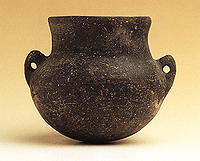
 Early Minoan styles have many common features, but there are also
distinct types, and strong local features.
After their successful introduction onto the market, the different ceramic styles
spread, a phenomenon which shows that
during the Early Bronze Age communication between
the different parts of Crete took place. In the beginning of the Early
Minoan period the production of Final Neolithic vessels,
the Scored Ware and the Pyrgos style, continues. But around the middle of this period
rapid changes in style as well as the production of new shapes took place.
The round shapes of this period are considered to be based on the 'askos' or the pumpkins
which may also have been used as drinking vessels.
Early Minoan styles have many common features, but there are also
distinct types, and strong local features.
After their successful introduction onto the market, the different ceramic styles
spread, a phenomenon which shows that
during the Early Bronze Age communication between
the different parts of Crete took place. In the beginning of the Early
Minoan period the production of Final Neolithic vessels,
the Scored Ware and the Pyrgos style, continues. But around the middle of this period
rapid changes in style as well as the production of new shapes took place.
The round shapes of this period are considered to be based on the 'askos' or the pumpkins
which may also have been used as drinking vessels.
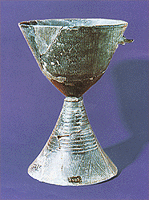 The Pyrgos style was common in northern and central Crete.
The surface of these vessels was dark and had a plain glaze, burnished or even linear
decoration which covered only certain parts of the vessels. A rudimentary version of
this style was the style of Partira. The most usual shapes of this category
were the skyphoi and the skyphoi with stand.
The pottery style of Agios Onouphrios is widespread in
central Crete. The surface of these vessels is decorated with clusters of lines
of a reddish paint and the most common shape is the round jug.
The Lebena style, found mainly in southern Crete is has a characteristic white
decoration applied on the red background, of various shapes.
The Pyrgos style was common in northern and central Crete.
The surface of these vessels was dark and had a plain glaze, burnished or even linear
decoration which covered only certain parts of the vessels. A rudimentary version of
this style was the style of Partira. The most usual shapes of this category
were the skyphoi and the skyphoi with stand.
The pottery style of Agios Onouphrios is widespread in
central Crete. The surface of these vessels is decorated with clusters of lines
of a reddish paint and the most common shape is the round jug.
The Lebena style, found mainly in southern Crete is has a characteristic white
decoration applied on the red background, of various shapes.
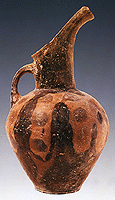 During the Early Minoan II period there is a considerable improvement in
the quality of ceramics.
In addition, well organized workshops have been uncovered, such as that of
Myrtos, where wheels were recovered. A new shape of this period
was the so-called teapot, a vessel with a round body and a projecting spout.
A widespread style was the decorated Gray ware,
and the Vasiliki ware, a typical category of mottled decoration.
The Koumasa ware, noted for its rich dark colour decoration
seems to have been a development of the Agios Onouphrios ware.
During the Early Minoan II period there is a considerable improvement in
the quality of ceramics.
In addition, well organized workshops have been uncovered, such as that of
Myrtos, where wheels were recovered. A new shape of this period
was the so-called teapot, a vessel with a round body and a projecting spout.
A widespread style was the decorated Gray ware,
and the Vasiliki ware, a typical category of mottled decoration.
The Koumasa ware, noted for its rich dark colour decoration
seems to have been a development of the Agios Onouphrios ware.
During the Early Minoan III period the vessel shapes undergo a slight modification. Conical base gradually replaced the high stand of the cups while the cups with round or hemispherical sides become common. Early Minoan II styles were gradually abandoned and the new styles that dominated consisted of dark, linear designs on light clay, and the vessels of the so-called White style, with a dark glaze and thick white decoration. This style occurs throughout the island, but came to the east rather later, and is considered to be the forerunner of the Kamares ware of the Middle Minoan period.