 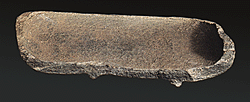
The stone industry of the Neolithic Period included, apart from stone polished tools, vessels as well. The earliest specimens date, on the basis of the finds from Sesklo and Achilleio in Thessaly, to the Early Neolithic. The production of stone vessels during the advanced Early Neolithic in Thessaly and southern Greece seems to have been on the increase, while during the Middle Neolithic it was extremely small. Examples of stone vessels from Macedonia and the islands go back to the Late Neolithic. |
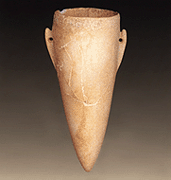
Slate, ofit and marble were some of the materials in which stone vessels were carved. They were small in size as a rule: with a diameter or length of 4-15 cms and a height of 2,5-17 cms approximately. The variety of shapes, which to a large extent imitated pottery protopypes, such as semiglobular bowls with a ring base, bowls with a flattened base and bowls with a leg are typical. At the same time there were shallow vessels, such as ellipsoidal or four-sided plates. Marble bowls with straight sides and a ring base from Saliagos in the Cyclades from the late Neolithic stand out among the finds, as well as a conical cup, with a pointed or flat base from finds on Kea, Naxos and Samos. |
| Because of the small size of the stone vessels, their use on a daily basis is rather puzzling. Moreover, their skilful and time-consuming manufacture indicates some peculiarity in their use, which has still to be discovered. Pigment traces at the bottom of certain stone bowls suggests that they were used as mortars for grinding and the further storage of earth colours (heamatite, malachite or azourite), used to adorn the body. |