 I express simple things; without having such an intention I am smooth-tongued. Of course I wouldn΄t know that if many of my interlocutors had not told me so nor if those listening to my speeches had not been languishing from pleasure ...' Chronicle, book 6th, chap. 44 (transl. Α. Sideri, Agra)
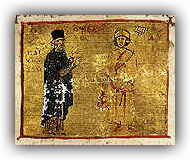
This is how the most eminent intellectual and writer of Byzantium describes the influence of his complex personality on his contemporaries. Erudite and prolific, Psellos was born in Constantinople in 1018, where, despite the limited economic means of his bourgeois family, he received a good education and made an important career for himself in the corridors of the Byzantine court. Imperial chancellor, chamberlain, prime minister and counsellor, he served emperors from Constantine IX Monomachos (1042) to Michael VII Doukas (1071). The first emperor gave him the title of hypatos ton philisophon and the chair of philosophy in the higher educational institute he created in Constantinople.
I express simple things; without having such an intention I am smooth-tongued. Of course I wouldn΄t know that if many of my interlocutors had not told me so nor if those listening to my speeches had not been languishing from pleasure ...' Chronicle, book 6th, chap. 44 (transl. Α. Sideri, Agra)
This is how the most eminent intellectual and writer of Byzantium describes the influence of his complex personality on his contemporaries. Erudite and prolific, Psellos was born in Constantinople in 1018, where, despite the limited economic means of his bourgeois family, he received a good education and made an important career for himself in the corridors of the Byzantine court. Imperial chancellor, chamberlain, prime minister and counsellor, he served emperors from Constantine IX Monomachos (1042) to Michael VII Doukas (1071). The first emperor gave him the title of hypatos ton philisophon and the chair of philosophy in the higher educational institute he created in Constantinople.His vast opus includes studies in theology, liturgics, philosophy and law. He took to the study and annotation of ancient philosophers, of mathematics, music and astronomy. A very interesting work, evidence of his multi-faceted mental enquiries is the Didaskalia Pantodape, which constitutes a short theological and scientific disquisition of 201 entries that gives answers to significant questions of human existence.
Apart from his scientific writings, Psellos is believed to have written several works of literary interest, along with many hundreds of epistles, poems, homilies, funeral orations and encomia of eminent personalities of the times. Finally, his Chronicle covers the period from 976 to 1077.