 |
||
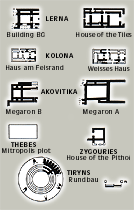
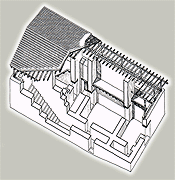
During the EH II period monumental buildings are built in settlements of south Greece. These are distinguished for their complex architectural design and the uncommon construction details. Researchers connect these buildings with the economic and social changes of this period. They are usually interpreted as political-administrative and economic centres of the EH communities. These buildings are two-storey, rectangular (e.g. 25X12 metres) stone constructions with strong foundations (1 metre thick) and mudbrick superstructure. The walls are buttressed with wooden beams placed horizontally and vertically. For the construction of the storey wooden beams, tree trunks and clay were employed. The roof is two-sided and consists of a wooden frame covered with reeds and straw clay. The roofing is completed by rectangular tiles of fired clay, an element never occurred before in the architecture of the prehistoric Aegean and which occurs almost exclusively in this type of buildings. The first was excavated at Lerna in the Argolid and was named according to its diagnostic element "House of the Tiles". Apart from the thousands of tiles the edges of the roof are covered with slate plaques. These buildings are freestanding and not always in the same place of the settlements (in the centre or near the fortification wall). They occupy an area of 147 (the "Fortified Building" - Thebes) to 300 square metres ("House of the Tiles" - Lerna III). The ground floor includes a large main room with one or two rooms on the side of the main entrance an one behind the main room. On the long sides of these rooms are narrow corridors on which the wooden steps that lead to the upper floor are placed. The existence of corridors led the archaeologists to the definition of these buildings as "Corridor Houses", thus differentiating them from the simple rectangular ones. The main room is equipped with a central clay hearth of a 1,5 metre diametre. Its rim is elaborately decorated by a clay cylinder seal. The arrangement of the area of the storey is not necessarily the same with the ground floor arrangement. It includes residential rooms, storerooms as well as porticoes (e.g. "White House" - Aegina III). The finding of 143 clay sealings, in a "blind" room of the ground floor of the "House of the Tiles" at Lerna which sealed the content of wooden boxes and storage vases in combination with the singularity of these imposing constructions constituted the beginning of many opposing opinions on the function of the "Corridor Houses". According to these versions they were either public buildings of an administrative and economic character (regional hierarchies) or the habitations of powerful families with workshops, storerooms, etc.. |
 |
|
|
Aegina III. Reconstruction
of the White House.
|
||
 |
||
|
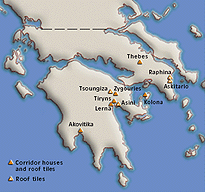
Sites with Corridor
Houses.
|
||
|
|
||