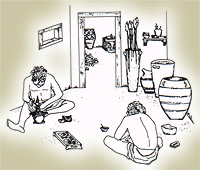
 Faience is a composite material made of pulverized quartz,
sandstone or chert, and a sodium carbonate solution. The liquid mix
of these materials was placed in moulds and fired at a high temperature,
about 870 o C. During this stage
it solidified while the outer coat melted
giving an opaque, lustrous appearance to the surface of the articles resembling ivory.
In order to obtain the deep blue colour characteristic of Egyptian faience,
the surface of the objects was coated with a solution of copper oxide and sand and
then fired again.
Faience is a composite material made of pulverized quartz,
sandstone or chert, and a sodium carbonate solution. The liquid mix
of these materials was placed in moulds and fired at a high temperature,
about 870 o C. During this stage
it solidified while the outer coat melted
giving an opaque, lustrous appearance to the surface of the articles resembling ivory.
In order to obtain the deep blue colour characteristic of Egyptian faience,
the surface of the objects was coated with a solution of copper oxide and sand and
then fired again. 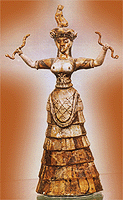 Because composition, faience was often
confused with glass paste and real glass, which were also used during the Bronze Age.
Although the processing technique is mostly known from Egypt where faience was used from the
fourth millenium, this art seems to have been imported to Crete from Syria and Mesopotamia.
Because composition, faience was often
confused with glass paste and real glass, which were also used during the Bronze Age.
Although the processing technique is mostly known from Egypt where faience was used from the
fourth millenium, this art seems to have been imported to Crete from Syria and Mesopotamia.
The earliest examples of faience in Minoan Crete appear a little before the end of the Early Minoan period (3000-2000 BC). Faience was employed in the manufacture of utility vessels, ritual objects and anthropomorphic and zoomorphic figurines. It was also used in jewelery and seal carving as well as for bead making, amulets and a great number of decorative plaques of various shapes and sizes. Faience was also used as a complementary decorative material on articles made of other materials.
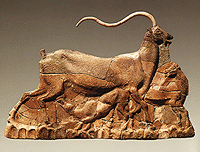 The style of Minoan faience is characterized by polychromy,
inventiveness and a preference for naturalistic themes. Certain techniques and
decorative features suggest that this art adopted elements from other Minoan arts such as
stone carving and metalwork. Knossos was an important centre of faience production
during the Middle Minoan I period (2000-1550 BC) Another faience
processing workshop was found in Zakros dating from the Late Minoan I period (1550-1450 BC).
The style of Minoan faience is characterized by polychromy,
inventiveness and a preference for naturalistic themes. Certain techniques and
decorative features suggest that this art adopted elements from other Minoan arts such as
stone carving and metalwork. Knossos was an important centre of faience production
during the Middle Minoan I period (2000-1550 BC) Another faience
processing workshop was found in Zakros dating from the Late Minoan I period (1550-1450 BC).
The art of faience, just like other art forms which first appeared in Crete, was also widespread on the Greek mainland. As early as the Middle Bronze Age (2000-1600 BC) simple jewels were being made of faience on mainland Greece while organized faience processing workshops may have functioned in the larger centres of the Mycenaean world. There was a faience workshop in Mycenae during the period of shaft graves (1600-1500 BC). Faience finds were often found in central Europe and in the British Isles along with other Mycenaean products. The artistic style and processing of these finds resemble other Aegean finds to such an extent historians have been wondering whether these finds are related to the trading activities of the Mycenaeans, and more precisely to their search for raw materials in these countries.