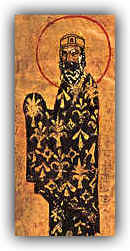
 after the period of crisis that followed the death of Basil II in 1025. Alexios I (1081-1118) brought the military aristocracy to the fore, created a closed core of influential advisors and officials around his family and a few, selected aristocratic families, and generally tried to repair the cracks in the Byzantine state. For the capital, as well as many urban centres, it marked a development which was bound together with changes in agriculture, trade and manufacture.
An important development was the introduction of the institution of pronoia, according to which many peasants found themselves dependent no longer on the state but on some private individual.
The difficulties that had already appeared, however, in the last years of Manuel Komnenos΄ (1143-1180) reign, led immediately after his death to problems in every sector of the Byzantine state. Westerners increasingly exploited opportunities in the mercantile sector, to the detriment of the Byzantines. The large-scale landowners exploited the agricultural population more and more. The heavy taxation necessitated by the economic crisis in the age of Angeloi led the most populous social group, the peasantry, to widescale pauperization and discontent.
Thus the structures built by the first Komnenoi lacked strong foundations, and paved the way for the collapse of the state in the 12th century during the reign of the Angeloi.