|
|
|
 |
|
John Chrysostom was the archbishop of Constantinople from 398 to 404. He is considered as a Great Father of the Church
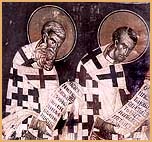 and
an ecumenical teacher on account of both his saintly life and the unique appeal
of his vast literary output. and
an ecumenical teacher on account of both his saintly life and the unique appeal
of his vast literary output.
He came from an distinguished Antioch family, into which he was born some time before 354.
Secundus, his father, was a high-ranking army officer who died soon after John
was born. His young mother devoted herself exclusively to their son's
education. John received an excellent education in the flourishing teaching centres
of the great city of Antioch, where ecclesiastical education and classical Greek
wisdom were cultivated by eminent scholars and philosophers. He was then
proclaimed reader, then a deacon, and in 386 was made presbyter and finally, on 26 February 398,
archbishop of Constantinople.
Applying the models of preaching he had learnt in Antioch, he embarked on a
mission of moral purification amongst Constantinople society. He was assisted
by a whole group of clergymen and women devoted to the Church that he had
assembled. His work established him as an eminent figure in public and social
life not only in the capital city but also throughout the Empire. He lent
unprecedented prestige and influence to the office of archbishop, which earned
Chrysostom important enemies. These finally managed to break up his followers, to unfrock the archbishop and send him into
exile along the borders of Armenia and Cappadocia. In
fact, he was forced to move to the Black Sea, as many of his followers visited
him in exile. John died on his way to the Black Sea on 14 September 407. In addition to
his social activity, he was a masterly ecclesiastical writer. His sermons occupy a
central position in his work, which also includes studies, speeches and letters.
John enjoyed a truly ecumenical appeal and universal prestige among the
Byzantine clergy and theologians during the following centuries. This was the result both of his work
and the example he had set as a priest.
|
|
|




