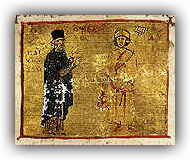
 He was Michael Psellos's student and it soon became apparent that he was unable to govern. He became a pawn in the hands of the eunuch Nikephoros or Nikephorides, who had risen though the hierarchy and become omnipotent. He acted according to his own interests and was indifferent to internal or external issues of state. The Emperor's policy in regard to the production of wheat in Rhaidestos is interesting. He tried to nationalize trade and imposed a lien on part of the quantity of wheat on sale. The lien was equal to one pinakion (small board) or 1/4 of a modius. For this reason the Emperor was nicknamed Parapinakes (alluding to his rapacity).
 In the reign of Michael VII, the administrative, military and economic situation of Byzantium suffered a severe crisis, a fact that external enemies took advantage of on all fronts. The Turks advanced further, occupying almost all central Asia Minor. Characteristic of the situation that prevailed after the defeat at Mantzikert is the attempt of the Norman mercenary chief Roussel de Bailleul to found a state in the East. Roussel΄s attempt was finally suppressed in 1074 due to the wiliness of the future Emperor Alexios Komnenos and the help of the Turks.
In southern Italy and Sicily the Normans consolidated their domination. In Bulgaria, the Byzantines suppressed a revolt led by Constantine Bodin with difficulty, while the Pechenegs and the Uzes continuously invaded and sacked Byzantine territory south of Danube. The economic situation was deteriorating and the result was a series of coup d'etats. The first to rebel, in 1077, was Nikephoros Bryennios. The leader of the coup d'etat, however, was Nikephoros Botaneiates, who overthrew Michael, forcing him to become a monk in the Stoudios Monastery. He then took the throne for himself.